Leaving Auschwitz

Leaving Auschwitz with the Israeli flag draped over our shoulders we proudly proclaim, “We are still here!” It is a rare occasion when one does not mind pointing, staring or whispering when you walk by. All week in Poland, we’ve demonstrated and practiced our Judaism in ways that are tremendous.

One of Judiasim’s tenants is tikkun olam, repairing the world. We accomplish this by taking our normal activities and doing them in a way that reveals a higher divine meaning. It is easy at home to go to a beautiful shul, wear a kippah on the street or eat a kosher meal. In Poland each of these acts takes on a special, extra meaning. Our very presence here is a source of light and hope.

Each time we daven we are fighting back against the harm done to Jews. Our group has brought prayer to shuls in Poland that had not heard Maariv in over 70 years. We have sung beautiful songs together, not only in sadness in front of the graves of children, but in celebration before the resting places of great Rebbes. We lained in Krakow, then danced in the streets singing nigguns. All of this tells the world that though the Holocaust was incredibly harmful, ultimately it was a failure.
The Children’s Forest

I’m getting tired of washing my hands. I understand why we wash after visiting a gravesite. I wish we did not have to do it today.

There is a mass grave in the forest outside Tarnow that should not exist. Mass graves are unfortunately common in Poland. This one is different. Eight hundred children are buried here. Eight hundred children beaten to death, at night, in the forest. The forest at night is already a frightening place for a child. Thinking of them, separated from their parents, marched in to the woods by strange men and savagely killed should only exist in a person’s nightmares.

A blue metal fence with widely spaced pickets surrounds the site. Piles of burnt out candles and faded flowers line the perimeter. The top of the stone memorial is covered in colorful clay statues. Little toys with which little hands can no longer play.

The sense of loss here resonates with such strength that it’s overwhelming. It’s physically difficult to walk up to that fence. Then, when it’s time to leave, my feet are rooted to the ground. I’m a father who loves his children more than anything else. That emotion pours from me for the children lying here. While they cannot physically leave this forest in Poland their souls will be traveling me with for ages yet to come.

Walking in Majdanek

I’ve stood in many special places. I’ve hiked up mountains to stand on summits. I’ve stood in Notre Dame to see the pinnacle of medieval architecture. I’ve walked the streets of the old city in Jerusalem, pressed my head against the Kotel and felt the presence of Hashem. Today, I walked through the Majdanek concentration camp.

Majdanek is not a monument in stone like Treblinka. Majdanek still has the gas chambers where my people were killed and the barracks where tens of thousands dwelled in squalor. Majdanek is where the foundation for the road is crushed headstones from Jewish cemeteries. It is the crematorium where the gassed bodies were burned and the mass grave of 18,400 Jews who were shot in a single day.

Today I walked the paths of a concentration camp. I stood where mothers refused to be separated from their children. I was barely able to stand in front of 400,000 pairs of shoes. Then, standing under a mausoleum, in front of the ashes of the victims, I said Kaddish and cried.

Treblinka

The steel gray clouds feel lower here. There is an eerie quiet broken by the crunching of gravel beneath our shoes. We are waking between horizontal slabs of stone marking the old railroad tracks and a white ribbon, winding through the trees, marked with the names of Treblinka’s victims. Nothing of the camp remains standing. Now there are just monuments and trees.

The silence is fitting. This place deserves to be still now. The camp was in operation for 13 months. In those 13 months 900,000 people were killed. 67 escaped. It is impossible to understand how anyone was able to avoid being killed. Jews were taken from the train, stripped of their possessions and marched into the gas chamber. There were no barracks, no beds, no cells. People were brought here to be turned into corpses.

In a single day up to 17,000 people would be killed. This number is remembered by fragmented stones that sit on top of concrete covered mass graves. These stones have the names of villages and towns that no longer exist. Among the countless names of places, one person is memorialized, Janus Korczak.

Korczak ran the orphanage in the Warsaw Ghetto. When his children were selected to be sent to Treblinka, Korczak was given a pass. He, however refused to abandon his children. He accompanied them from the ghetto, onto the train and all the way to the end. The weight of that decision lies heavy around us. Hearing just this one story is heartbreaking. Waking away there are 899,999 stories that we will never know.

Starting in Warsaw

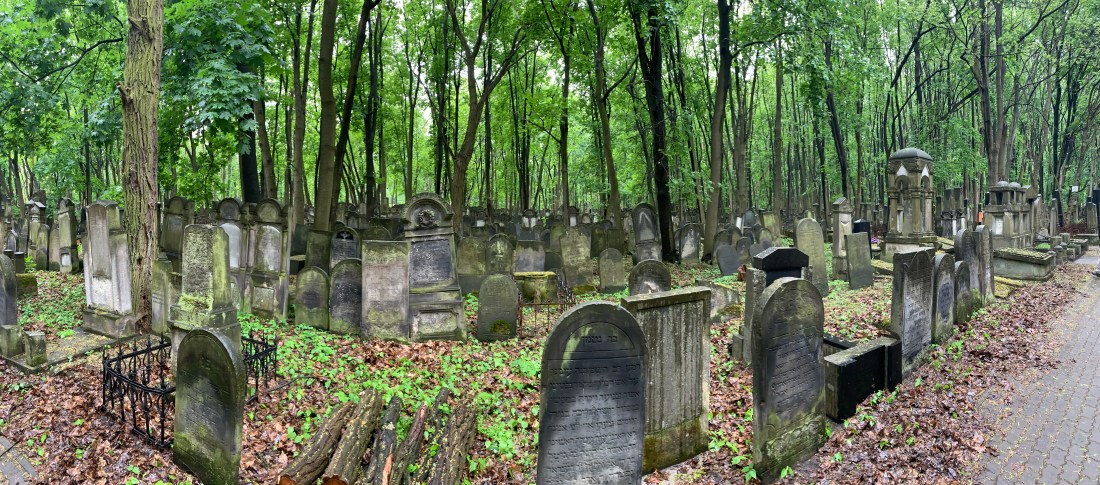
We’re definitely not in Kansas anymore. The Warsaw Cemetery is a massive place, surrounded by high brick walls and crossed by cobblestone paths. Its very being washed away our travel fatigue and subtlety proclaims, “Now we begin.”

The cemetery has no neat rows, no symmetry or straight lines. Each plot has its own personality, each stone tells a story. One monument is four marble pillars, seven feet tall. Another is covered in intricate carvings depicting the deceased’s career in Yiddish theater. A third is covered in creeping vines and surrounded by flowers. Everything deep in shadow cast by thick branches on ancient trees.

It’s fitting that it continues to rain as we walk between the mass graves of 100,000 Jews who died from starvation and disease in the Warsaw Ghetto. The ghetto itself does not exist anymore. Where there were 300,000 thousand Jews there is now a museum and some monuments outside newly constructed apartment buildings.

This shocks and scares me. In a span of three years a thriving and affluent population vanished. There was literally nothing left behind. Now there are just monuments scattered between newly constructed apartment buildings. As we stand where Jews were sent to Triblinka, traffic rushes by, the light rail brings commuters home and a band starts playing rock music across the street at a music festival. I’m glad I’m on this trip.